Preparing for the FDA’s Proposed GRAS Rule: What Food Ingredient and Food Contact Material Manufacturers and Suppliers Need to Know

03 Sep 2026
The United States (U.S.) Food and Drug Administration (FDA) recently proposed a rule change which would transform its voluntary notification structure for Generally Recognized as Safe (GRAS) substances into a mandatory pathway.
In the first article of this series, we explored the United States Food and Drug Administration’s (FDA's) proposed rule that, if finalized, would require the submission of Generally Recognized as Safe (GRAS) notices to FDA for certain uses of substances that are currently eligible to be supported by an independent GRAS conclusion.
While the proposal is now open for public comment and moves through the regulatory process, many companies are asking a practical question: what should we be doing today if we currently rely on independent GRAS conclusions?
The reality is that, regardless of whether the FDA’s proposal is finalized as written, modified, or ultimately withdrawn, this is an ideal time for organizations to take a fresh look at their existing GRAS programs. Companies that understand their portfolios, regulatory status, and supporting data today will be better positioned to respond to future regulatory developments.
What You’ll Learn
For companies currently relying on independent GRAS conclusions, now is the time to understand which products may be affected, assess the strength of existing supporting documentation, and identify potential regulatory pathways. This article outlines several practical steps companies can take now to prepare.
Start With a Portfolio Inventory
One of the first challenges many companies face is identifying which substances and products in their portfolio rely on a GRAS conclusion established by the company or a third party, and determining whether the supporting scientific and regulatory documentation is complete and readily accessible.
For companies that manufacture or supply both food ingredients and food-contact materials, the inventory should extend beyond GRAS substances alone. Companies should identify the regulatory basis for each substance, feedstock, or product, including the applicable conditions of use, and confirm that appropriate documentation supports its intended use.
For some organizations, this may involve only a handful of products. For others, particularly large ingredient manufacturers and food contact material suppliers, the list can be surprisingly extensive.
A thorough portfolio inventory should consider, as appropriate:
- Food ingredients;
- Processing aids;
- Functional additives;
- Food contact substances;
- Packaging components;
- Adhesives;
- Coatings;
- Polymer additives; and
Recycled materials and their constituents.During this type of exercise, many companies discover that their regulatory documentation is distributed across multiple departments, manufacturing sites, suppliers, or historical acquisitions. Establishing a clear inventory creates the foundation for every other preparedness activity.
Review the Regulatory Basis for Each Product
Substances and products within a portfolio may be supported through different regulatory pathways. For each substance or product, companies should identify the applicable regulatory basis, which may include:
- An independent GRAS conclusion;
- An FDA GRAS notification;
- A Food Contact Notification (FCN);
- An existing food additive regulation;
- A Threshold of Regulation (TOR) exemption;
- A prior sanction; or
- Another applicable regulatory pathway.
These distinctions matter because the proposed rule would affect certain uses currently supported by independent GRAS conclusions, while other substances may be subject to separate regulatory requirements or remain outside the scope of the GRAS notification framework.
Understanding the current regulatory foundation for each product can help organizations identify where future effort may or may not be required.
Assess the Strength of Existing Safety Support
An independent GRAS conclusion depends on the quality, completeness, and currency of the scientific evidence and documentation supporting it.
For many products with long-standing independent GRAS conclusions (“legacy” products), supporting documentation may have been developed years ago. Scientific understanding evolves, manufacturing processes change, and exposure assumptions can shift over time. Companies should therefore take this opportunity to evaluate whether the scientific and technical information supporting existing GRAS conclusions remains current and representative of the substance and its intended use. For food-contact substances, a similar preparedness review should be conducted under the applicable FDA food-contact regulatory pathway, with particular attention to the substance's identity, composition, conditions of use, migration, and supporting toxicological information, as applicable.
Areas for review may include:
- Toxicology assessments;
- Exposure and dietary intake evaluations;
- Manufacturing descriptions;
- Specifications and Certificates of Analysis;
- Safety narratives;
- Expert panel reports, where applicable;
- Published scientific literature supporting safety conclusions.
- Identity and composition of the substance;
- Conditions of intended use;
- Impurity and degradation product profiles, where relevant;
- Generally available scientific evidence supporting the GRAS conclusion; and
- Any potentially adverse or inconsistent information identified during the safety review.
For food-contact materials, the regulatory assessment should be conducted separately based on the applicable food-contact pathway. Companies may also want to evaluate:
- Migration assumptions and supporting data;
- Food types and Conditions of Use;
- Consumer exposure estimates;
- Extractables and leachables data, where relevant; and
- Compliance with applicable FDA requirements and appropriate analytical methods and standards.
A gap assessment can identify areas where documentation or supporting data may need to be updated, even if the proposed regulatory changes do not ultimately take effect.
The proposed rule also includes requirements concerning the language and format of information submitted to FDA. Companies with globally developed or maintained dossiers may therefore benefit from reviewing the accessibility, organization, and format of their existing documentation.
Verify That Manufacturing Processes Have Not Changed
A GRAS conclusion may have been developed based on the identity and composition of a substance, as well as a specific manufacturing process, purification step, raw material source, or product specification. Over time, however, companies may improve their processes, change suppliers, expand production capacity, or substitute raw materials.
Companies should evaluate whether their current commercial products remain consistent with the substance, manufacturing process, specifications, conditions of use, and safety assessment that formed the basis of the original GRAS conclusion.
Even seemingly minor changes can affect whether existing safety evaluations remain fully representative of the product currently being marketed.
For food contact substances, a similar review should confirm that the current commercial product and conditions of use remain consistent with the applicable FDA authorization or other regulatory basis.
Extend the Review to Food-Contact Materials
Much of the public discussion surrounding the proposed GRAS rule has focused on food ingredients. However, many companies operate across both food ingredients and food contact material markets. For these organizations, the proposed changes provide an opportunity to review the regulatory foundation supporting their broader portfolio.
Companies involved in the manufacture or supply of the following should evaluate the regulatory basis and the supporting documentation for their products:
- Plastic packaging;
- Fiber-based food-contact materials;
- Coatings;
- Adhesives;
- Pigments;
- Printing inks and related components;
- Recycled packaging technologies;
- Sustainable packaging solutions; or
- Novel material technologies.
For food contact substances, companies should confirm that the applicable FDA regulatory pathway is clearly documented and that supporting chemistry, migration, toxicology, and intended end-use information remains appropriate for the product currently on the market.
Evaluate Business and Supply Chain Risk
Not every product portfolio will present the same level of business or regulatory risk. Organizations should consider:
- Which substances generate the greatest revenue?
- Which products support strategic growth initiatives or key customers?
- Which products are sourced or manufactured globally or depend on a limited number of suppliers?
- Which products have the greatest regulatory uncertainty or data gaps?
- Which products have no readily available alternative regulatory pathway?
- Which products would be most difficult or costly to reformulate?
The answers to these questions can help companies prioritize their preparedness activities and allocate resources efficiently if new regulatory compliance obligations arise.
Begin Thinking About Potential Future Pathways
At this stage, companies do not necessarily need to make a final submission decision. However, they should begin understanding the potential regulatory pathways available if the proposed rule is finalized.
Depending on the substance, intended use, and regulatory status, potential pathways may include:
- A traditional GRAS notice;
- A proposed streamlined submission for certain existing uses, if the proposed provisions are finalized;
- An applicable existing FDA food additive regulation or other exemption;
- A Threshold of Regulation (TOR) exemption, where applicable; or
- A Food Contact Notification (FCN) for applicable food contact substances. [2026-16296 | PDF]
The most appropriate pathway will vary significantly from one substance to another. A substance currently supported by an independent GRAS conclusion may require a different strategy from a novel food contact substance or a substance already covered by an existing FDA regulation.
Understanding these possibilities now can help organizations prioritize resources, identify potential gaps, and avoid unnecessary delays if regulatory requirements change.
Common Gaps Seen During Preparedness Reviews
When companies revisit older independent GRAS programs, they commonly discover that their legacy dossiers have not been reviewed in years.
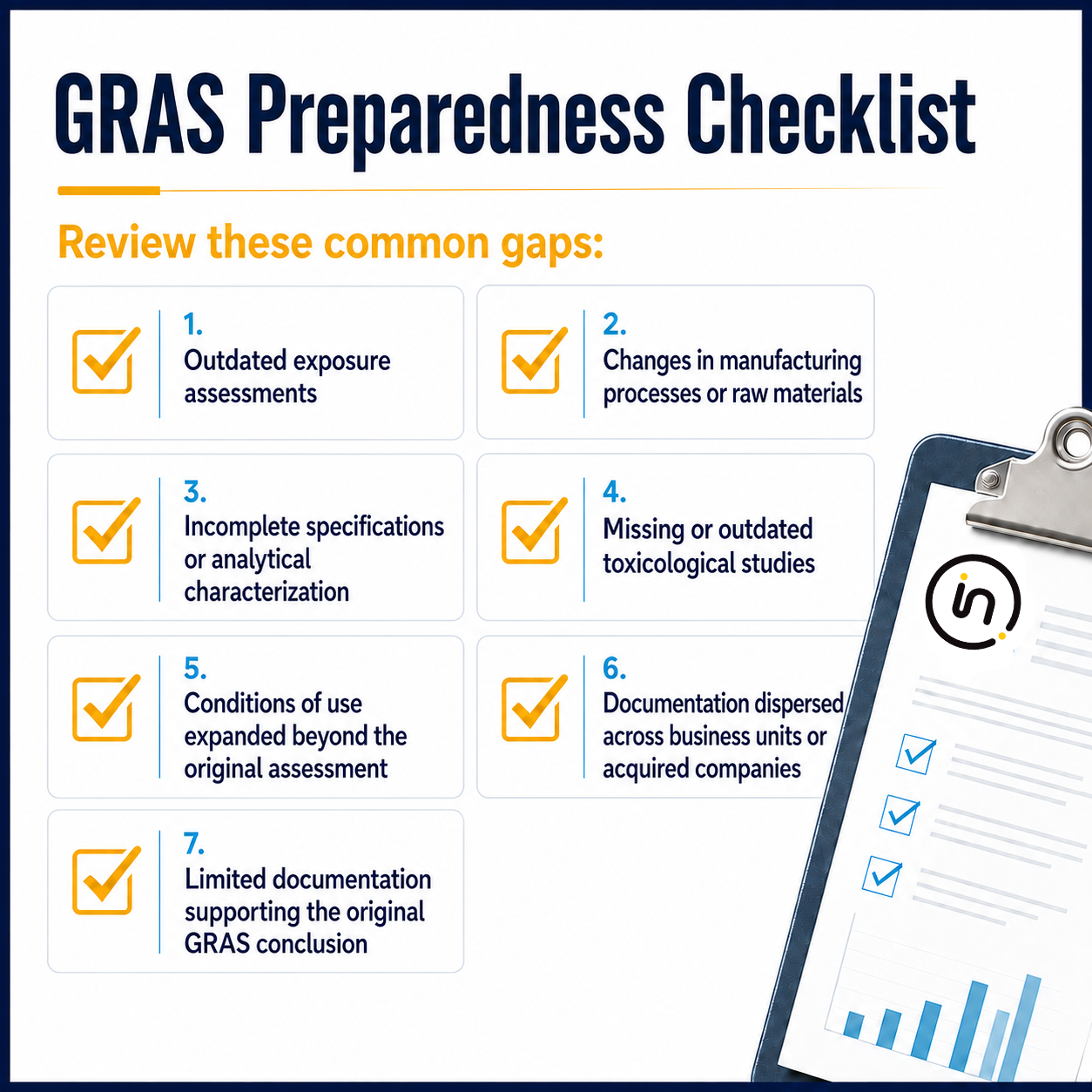
Identifying these issues before regulatory requirements change allows companies to address them proactively rather than reactively.
How Intertek Helps Companies Prepare
A comprehensive preparedness assessment may require regulatory, toxicological, analytical, exposure, and food-contact expertise, particularly when a company has a diverse portfolio spanning multiple regulatory pathways. Intertek brings these disciplines together so that regulatory strategy, scientific assessment, analytical testing, and food-contact evaluation can be considered as part of a coordinated preparedness strategy.
This integrated approach can help companies assess their current GRAS and food-contact portfolios, confirm the regulatory basis for individual substances and products, identify scientific and documentation gaps, and prioritize areas of regulatory risk. It can also help companies determine which regulatory pathways may be most appropriate and develop practical strategies for addressing identified gaps.
Now is the time to understand what is in your portfolio, confirm the regulatory basis for each substance and product, and identify potential scientific and documentation gaps in anticipation of potential new FDA requirements. Intertek can help companies prioritize areas of risk and develop practical regulatory strategies as the FDA regulatory landscape evolves.
In the third and final article in this series, we will explore four regulatory strategies companies currently relying on independent GRAS conclusions may want to consider if FDA’s proposed rule is finalized.
This article is intended for general informational purposes and reflects the FDA’s proposed rule as published on August 10, 2026. It does not constitute legal or regulatory advice. Companies should evaluate the applicability of the proposed requirements based on their specific substances, intended uses, and regulatory status